
Weatherstrip Historic Wood Windows in Boston | Whole Window
How to Properly Weatherstrip a Historic Wood Window: The Bronze Leaf-Spring + Silicone Bulb Seal System
A complete guide for Boston-area homeowners who want to keep their original wood windows — and stop the drafts at the same time.
Your old windows don't have to be drafty
If you live in a Greater Boston home built before 1940 — a West Roxbury Victorian, a Brookline brick row house, a Cambridge triple-decker, a Jamaica Plain Colonial Revival — chances are at least one of your windows lets in a noticeable cold draft on a January morning. Most homeowners assume that's the price of keeping the original wood sash. The replacement-window industry has built a multi-billion-dollar business on that assumption.
It isn't true.
A properly weatherstripped historic double-hung window, paired with a modern storm window, will outperform a typical vinyl replacement on air infiltration and match or exceed it on overall thermal performance. The Window Preservation Standards Collaborative proved this in 2011 at their Pine Mountain summit, testing restored windows under ASTM E1186-03. All five tested upgrade levels exceeded the 2009 International Energy Conservation Code; four of five exceeded the 2012 IECC.
But there's a catch: the weatherstripping has to be done right. And "right" means understanding that a double-hung window leaks in four distinct places, each requiring a different sealing approach.
The four leak zones of a double-hung window
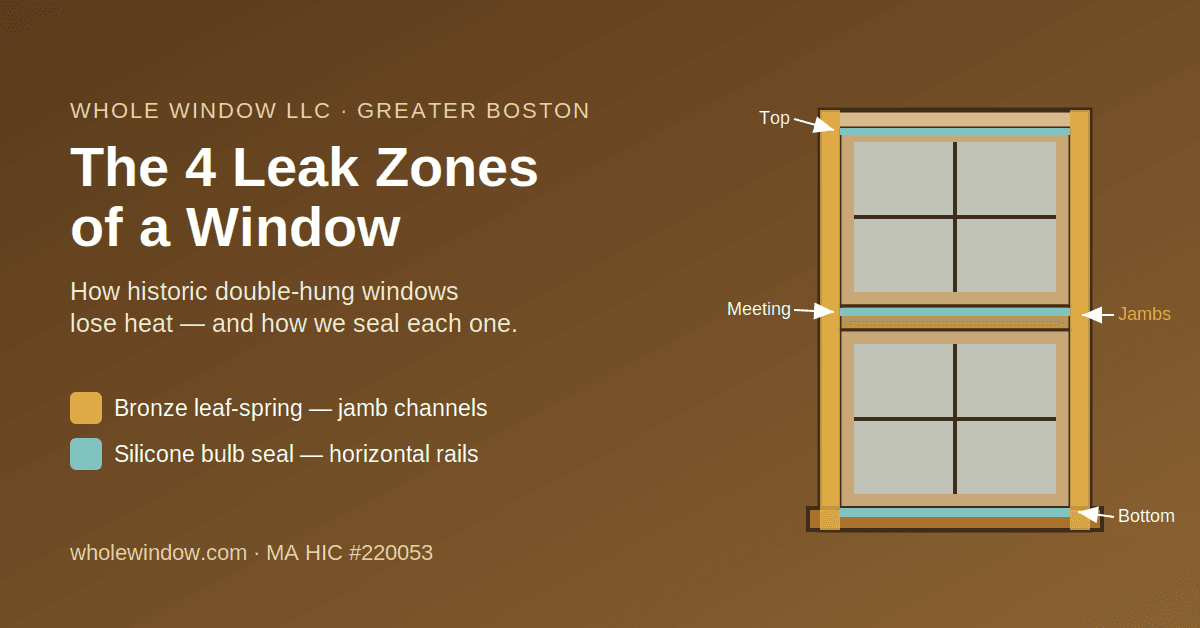
When a homeowner says "my window is drafty," air is actually finding its way through four separate paths:
The two vertical jamb channels — where the sides of each sash slide up and down against the frame.
The bottom rail — where the bottom of the lower sash sits on the windowsill.
The meeting rails — where the top of the lower sash and the bottom of the upper sash overlap in the middle.
The top rail — where the top of the upper sash meets the head jamb.
[Suggested image: cutaway diagram of a double-hung sash with the four leak zones color-coded.]
A complete weatherproofing job seals all four. Miss any one and the window will still feel drafty.
The two best materials for the job — bronze leaf-spring and silicone bulb seal — each handle different zones. At Whole Window we use them in combination on virtually every restoration.
Bronze leaf-spring: the gold standard for the jamb channels
The vertical jamb channels are the largest leak zone — typically 60–70% of total air infiltration on an unsealed window — and they're also the trickiest to seal, because the sash has to slide freely up and down while the seal stays tight.
The solution invented in the late 19th century and refined ever since is bronze leaf-spring weatherstripping. It is a thin strip of zinc-coated steel or phosphor bronze, formed into a V- or L-profile, installed in a shallow routed kerf in the jamb. The "leaf" stays sprung against the side of the sash with light, constant tension — sealing the channel against air movement while letting the sash slide freely.
Why bronze (or phosphor bronze) specifically:
Lifespan of 50+ years. Original bronze weatherstripping from the 1920s is still working in plenty of Boston brownstones today. Compare that to vinyl V-strip (5–10 years) or foam (1–3 years).
It doesn't take a set. Foam and felt slowly lose their loft. Bronze springs back every cycle.
It's invisible when the window is closed. Tucked into the jamb channel, it doesn't show from inside or outside.
It preserves historic character. Required or strongly preferred by most local historic district commissions across Greater Boston.
Installation is exacting work. The jamb is routed precisely (we use a trim router with a custom bit), the bronze is cut to length, secured with small wood screws, and tensioned correctly — too loose and it won't seal, too tight and the sash binds. This is the part of a restoration where craft really matters, and where the difference between a five-year fix and a fifty-year fix shows up.
We work with high-grade zinc-coated and phosphor bronze stock made to specifications that haven't changed materially in 80 years.
Silicone bulb seals: the modern complement for the horizontal joints
Bronze leaf-spring is perfect for sliding vertical surfaces, but it is the wrong tool for the three horizontal joints — the bottom rail, the meeting rails, and the top rail. Those joints don't need to slide; they need to compress and re-seal every time the window opens and closes. For that job, modern silicone tube bulb seals are the right answer.
A bulb seal is a small hollow silicone tube — usually 1/4" to 3/8" in diameter — bonded to a flat carrier or installed in a slim kerf cut into the wood. When the sash closes, the bulb compresses against the mating surface and seals the gap, eliminating both drafts and noise. We use restoration-grade silicone bulb seal in the appropriate profile for each joint.
Silicone (not EPDM, not vinyl) matters here because:
It doesn't harden, crack, or take a set. A silicone bulb seal installed today will still be soft and sealing in 30 years. Vinyl seals get brittle in 5–10 New England winters.
It performs across the full temperature range. From a 95°F July afternoon to a –10°F February night, silicone stays flexible and resilient.
It tolerates UV and ozone — critical for any seal that sees sun through old glass.
Here is where each silicone bulb seal goes:
Lower part — bottom rail to sill
The biggest single-point leak after the jamb channels. We install a silicone bulb seal in a kerf cut into the underside of the lower sash so that it compresses against the sill when the window is fully closed. This seal stays invisible from inside and out, and it stops the cold air pool that otherwise spills off the sill onto your floor every winter.
Middle part — the meeting rails
This is the joint where the top of the lower sash and the bottom of the upper sash overlap. On an unrestored window the two rails are usually warped, painted shut, or simply not in contact — and a surprising amount of warm air escapes upward through this gap. We install a continuous silicone bulb seal in the underside of the upper-sash check rail so it compresses against the top of the lower-sash check rail when both sashes are pulled tight against the lock. Done right, this also dramatically reduces lock rattle and street noise.
Upper part — top rail to head jamb
Often overlooked, because the upper sash on most old windows is painted shut and assumed to be sealed. It isn't — paint cracks, gaps open, and warm air escapes through the top of the window as readily as through the bottom. After we free and re-balance the upper sash (an important step in itself — see our guide to sash cord and weight repair if your sashes won't stay up), we install a silicone bulb seal in the head jamb so it compresses against the top of the upper sash when the window is fully closed.
The integrated system: bronze + bulb seals working together
When all four leak zones are sealed — bronze leaf-spring on the two vertical jambs, silicone bulb seals on the bottom rail, meeting rails, and top rail — the result is a window that doesn't just feel less drafty. It is measurably tighter than a typical mid-priced vinyl replacement window.
Combine that with a properly fitted exterior storm window (we recommend wood storm sash on primary elevations of historic homes, or low-profile aluminum triple-track storms on secondary elevations) and you have a window assembly with:
An equivalent U-value of approximately 0.44–0.49 — better than ASHRAE's reference figure of 0.6 for a non-thermal-break double-glazed metal window.
Air infiltration meeting or exceeding the 2012 IECC.
Original old-growth wood and irreplaceable historic glass preserved.
A service life measured in decades, not years.
Why this matters more in Boston than almost anywhere
Greater Boston has one of the highest concentrations of pre-1940 housing stock in the country. West Roxbury, Roslindale, Jamaica Plain, Brookline, Chestnut Hill, Newton, Cambridge, Somerville, the South End, Beacon Hill — entire neighborhoods derive their architectural value from their original wood windows. Replacing those windows with vinyl is a permanent loss of character and resale value, and it is almost always financially worse over a 30-year horizon than restoring and weatherstripping the originals.
The numbers tell the story:
Embodied energy of a new window: approximately 2.3 million BTUs per unit, with a typical energy payback period of around 41.5 years (per Preservation North Carolina, citing engineer Keith Haberern).
Service life of a vinyl replacement window: typically 15–30 years.
Most vinyl replacements never reach energy payback before they need to be replaced again.
Service life of a restored and weatherstripped original wood window: 50–100+ years, with normal maintenance.
The old-growth pine, fir, or cypress in your original sashes — with 20–40 growth rings per inch — is denser, more rot-resistant, and more dimensionally stable than any wood being milled into windows today. It can't be replaced. It can be preserved.
How we do it at Whole Window
Every wood-window restoration we perform across Greater Boston includes a full four-zone weatherstripping package as standard. We:
Route in genuine bronze leaf-spring weatherstrip on both jamb channels
Install silicone bulb seals on the bottom rail, meeting rails, and top rail
Free and re-balance the upper sash so it can actually close tight
Tune the entire assembly so the window operates smoothly with one hand and seals with light pressure
Pair the restored window with the right storm window for the elevation
The result is a window that looks exactly the way it was meant to look in 1895 or 1920 or 1935 — and performs the way modern building science says it should perform in 2026.
Ready to stop the drafts?
If you'd like to talk about weatherstripping and restoring the wood windows in your Greater Boston home, we'd be glad to schedule a free in-person assessment. We serve West Roxbury, Roslindale, Jamaica Plain, Brookline, Chestnut Hill, Newton, Cambridge, Somerville, and the surrounding communities.
Weatherstripping seals how a window holds heat — but if your sashes won't stay up or feel painted in place, that's a balance problem worth fixing first. Our companion guide, why your old window won't stay up: sash cord & weight repair, covers that side of the job.
📍 1819 Centre St, West Roxbury, MA 02132
Whole Window LLC · MA Home Improvement Contractor #220053