
How to Repair a Rotted Wood Window Frame (Without Replacing the Window)
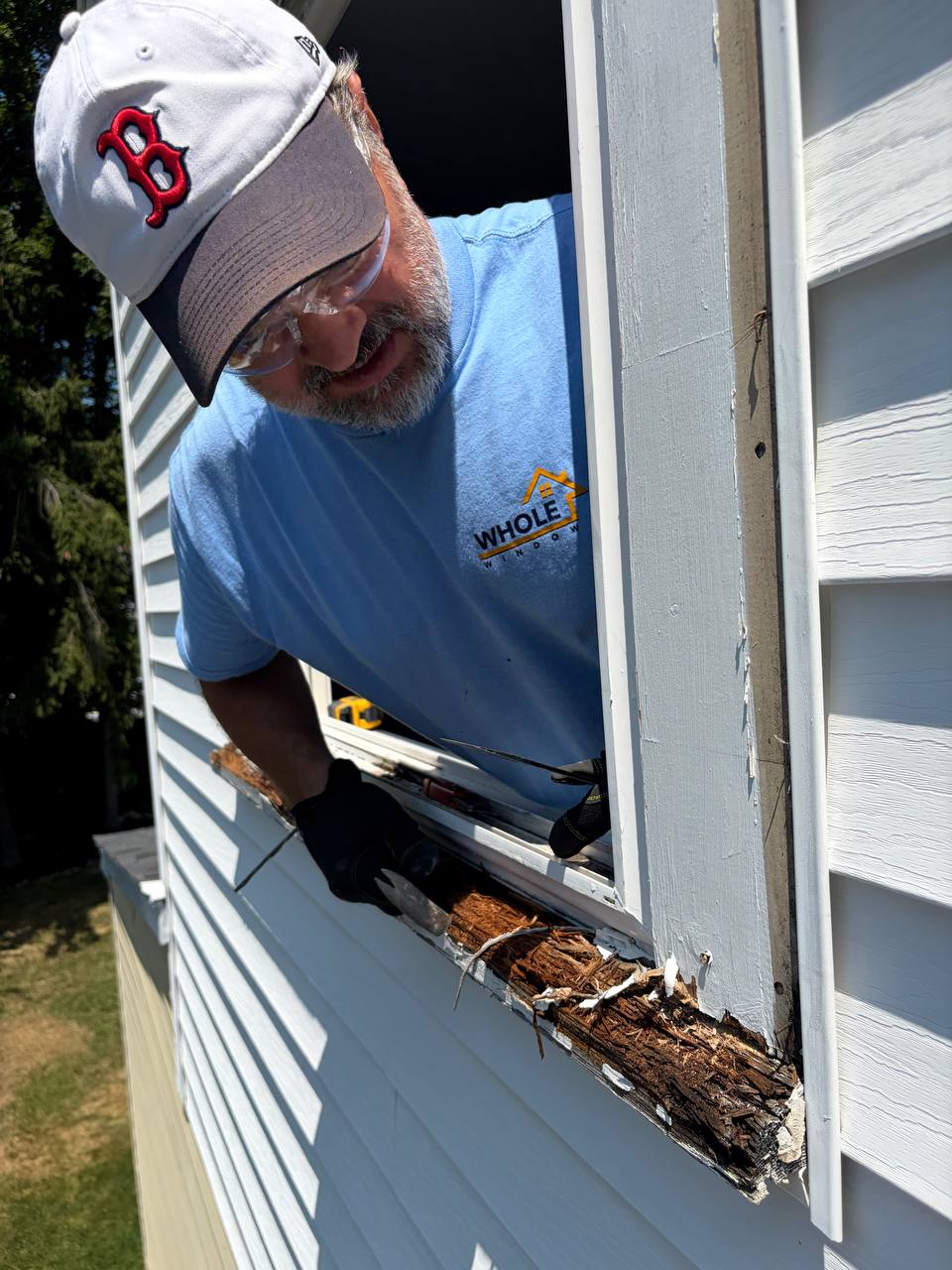
A wood window frame is built to last a century, but only if water stays out of it. When paint fails or the glazing cracks, moisture soaks into bare wood and the frame starts to rot. The good news is that a rotted window frame almost never means you need a new window. In most Boston-area homes the frame is repaired in place and the original window keeps working for decades more.
This guide covers how to tell real rot from cosmetic damage, how the repair is actually done, what wood filler can and cannot fix, what it costs, and the point where replacement is the honest answer.
Is it rot, or just ugly paint?
Peeling paint alone is not rot. Rot is wood that has lost its structure, and there is a simple test for it. Press a screwdriver into the suspect area with moderate pressure. Sound wood resists and the tip barely marks it. Rotted wood takes the tip with almost no effort, and it stays soft under the surface even after the loose material is scraped away.
Check these places first, because this is where water sits:
The sill, especially where it meets the side jambs.
The bottom corners of the frame and the bottom rail of the sash.
The exterior casing and trim, right where it meets the siding.
Any spot with a water stain, a dark streak, or bubbling paint below it.
Other signals that the frame is going: visible cracks and open joints, drafts you can feel with the window locked, a sash that sticks or will not latch, and mushrooms of paint that reappear a season after repainting.
Why wood window frames rot
Almost every case starts with a paint or glazing failure. Once the protective layer opens up, rain and condensation get into bare wood and stay there. What people call dry rot is a fungus that needs that trapped moisture to spread, and it keeps eating sound wood well past the spot where it started.
New England makes this fast. Water gets in, freezes, expands the crack, and lets more water in on the next thaw. A soft spot the size of a coin in October can be a structural problem by spring. That is why frame rot is worth catching early rather than watching for another year.
Repair or replace?
Replacement windows are marketed as the answer to a rotted frame. They rarely are.
Original frames in older homes are old-growth timber, denser and far more rot resistant than the wood in a modern unit, and they were designed from the start to be repaired piece by piece. Decay is also usually local: the bottom of the jambs, the sill, the exterior casing, while the rest of the frame is still sound. Cutting out a good frame to install a new window means tearing into the surrounding wall and trim, losing the original profile, and paying several times what the actual damage is worth.
Replacement becomes the honest answer in two situations. First, when the decay has taken most of the frame, not a section of it. Second, when the rough opening behind the frame is compromised, which is a framing and siding problem rather than a window problem.
How to repair a rotted wood window frame
The repair itself is straightforward. Doing it so it lasts is about being thorough at each step.
Open it up and find the full extent. Failed paint and old glazing come off first. Rot always runs further than it looks from outside, and repairing up to the visible edge is the most common reason a repair fails two years later.
Cut out all the decayed wood. Everything soft comes out, back to wood that resists the screwdriver.
Splice in new timber, or rebuild with structural epoxy. Where the section is large or load bearing, a matching piece of wood is cut and spliced in. Where a splice is not practical, such as an irregular profile or a corner, the section is consolidated and rebuilt with structural epoxy that can be shaped to the original detail.
Re-square and re-glue loose joints so the frame is solid again and the sash meets it evenly.
Fix the leak that caused it. Repairing the wood without correcting the water path just resets the clock.
Seal, prime, and paint every surface, including end grain and the underside of the sill, then re-glaze and weatherstrip as needed.
Done properly the frame is sound, weather tight, and ready for another generation, with the original woodwork preserved. See a full example in Before and After: a rotted wood window restored.
Wood filler, epoxy, and repair kits: what actually holds
This is where most DIY repairs go wrong, so it is worth being precise.
Standard wood filler is a cosmetic product. It fills nail holes and shallow surface defects, it does not bond to punky wood, and it has no structural strength. Packed into a rotted sill it looks perfect for one season, then cracks at the edges, wicks water behind itself, and hides the decay while it spreads. A frame that has been filled twice is usually worse than one left alone, because nobody looked underneath.
Two-part epoxy systems, meaning a liquid consolidant that penetrates and hardens remaining fibers plus a structural filler, are a different product entirely. They are legitimate for rebuilding sections and profiles. They also demand dry wood, correct mixing, real cure time, and complete removal of the decay first. Applied over damp or still-rotted wood, epoxy seals moisture in and accelerates the problem.
A window frame repair kit is fine for a small isolated spot on a frame that is otherwise sound. It is not a solution for a soft sill, a corner that has come apart, or rot that runs under the trim.
Should you do it yourself?
A small surface repair on a first floor window, in dry weather, is a reasonable weekend job. Beyond that the reasons to call someone are practical rather than promotional.
Anything above the first floor is ladder work over a hard surface. Cutting out and splicing structural sections needs the sash out of the way and a way to keep the opening weather tight until it goes back. Exterior wood work only holds if it is done in genuinely dry conditions, so half finished work and a wet forecast is a real risk. And in homes built before 1978 the paint you are sanding is likely lead paint, which brings real containment requirements. We follow EPA RRP guidelines on that work.
What rotted window frame repair costs
Real numbers from our own work in the Greater Boston area, so you can size the job before anyone visits:
Rotten sill replaced with PVC, including caulking and painting in the original color: $345.
One piece of window trim replaced with PVC: $145. Two side pieces: $290.
Sash repair, replacing the rotten wood: $295 for a partial repair, $495 to replace the lower section, $495 to $795 for rot repair including painting.
Prep and paint of sealed cracks: $195.
Rotten porch wood: $125 per piece.
General window restoration, meaning cords, glazing, and weatherstripping together: $250 to $650 per window.
The reason quotes for frame rot vary so much is the third step above. Until the failed paint is off, nobody can honestly say whether it is a $345 sill or a full section rebuild. Our assessment is free for wood, sills, and glass work.
What about rotted wood around the window?
Rot found beside the window rather than in it usually means the water is coming from the siding, the flashing, or the wall behind. We repair the window, the sill, the casing, and the trim. We do not work on house framing or siding, and a frame that has rotted through completely is past the point where repair is the right call. If that is what we find, we will tell you plainly instead of selling a repair that will not hold.
Get it looked at before winter
Whole Window repairs rotted and cracked wood window frames across Greater Boston, including Newton, Brookline, Needham, Wellesley, and nearby towns. We repair windows only, we do not sell replacements, so the recommendation you get is the one that fits the window.
Related services: rotten window frame repair, rotten window sill repair, rotten sash repair, and wood window repair.
Free quotes, 1 year workmanship warranty, optional 5 year extended warranty, Google 5 star. Call 617-982-1211 or send photos of the damage to admin@wholewindow.com for a free quote on your wood window frame repair.